
Strength, measured: Muscle People
Once reserved for elite sport, objective performance-testing technology is now helping everyday people recover with greater precision, see their progress and return confidently to the activities that matter.
How strong is your recovering arm or leg compared with the other side?
Has an injured shoulder or elbow regained the capacity needed for lifting, gripping, pushing or returning to sport? Are you producing force evenly when you squat, jump or perform a work-related task?
Has rehabilitation genuinely restored your capacity – or have you simply become better at compensating?
These questions can be difficult to answer through observation alone.
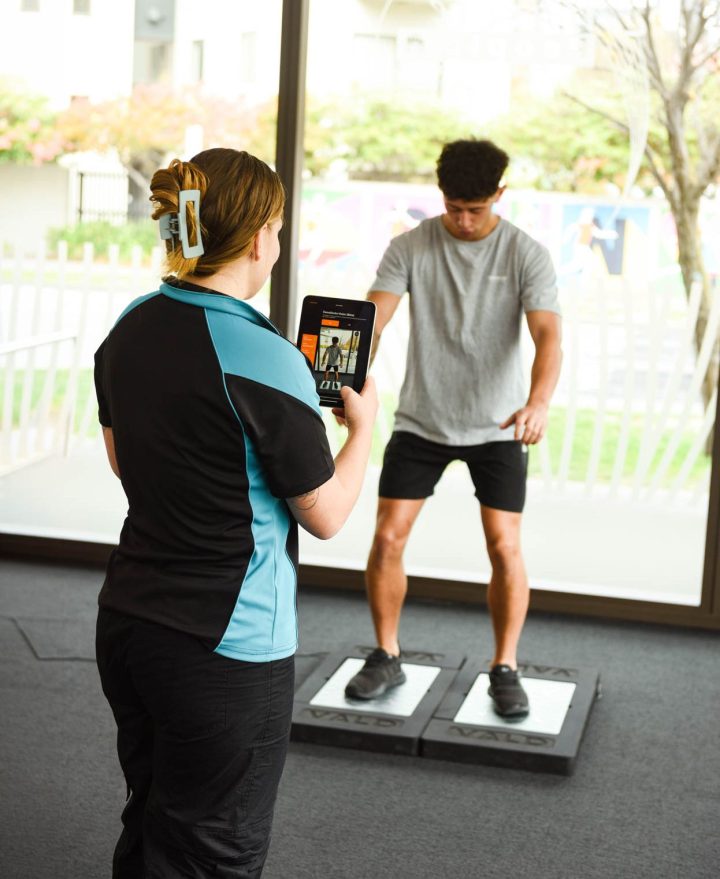
At Muscle People Physiotherapy, VALD assessment technology is adding objective measurement to the clinical picture.
Used internationally in high-performance sport, VALD systems measure aspects of physical performance such as muscle strength, power, balance, movement and differences between the two sides of the body.
For patients, this means rehabilitation can be informed not only by how movement looks and feels, but also by clear, repeatable data.
“Good physiotherapy still begins with listening to the patient and completing a thorough clinical assessment,” says Nicholas Moore, practice manager at Muscle People. “VALD complements that process. It can help us identify specific strength deficits, asymmetries and functional limitations, and then target rehabilitation more precisely.”
Beyond guesswork
A person can appear to move well while subtly protecting one side. Someone may have regained comfortable shoulder movement but still lack the strength required for lifting or sport. Another person’s elbow pain may be improving, while grip or load tolerance remains significantly reduced. Similarly, someone may feel ready to return to running, work or sport but still have an important lower-limb strength deficit.
Objective testing can make these gaps visible.
Depending on the individual and their goals, an assessment may compare strength between the right and left sides, measure grip or upper-limb force, assess how force is produced during a movement, or monitor changes throughout rehabilitation.
This can be particularly useful during rehabilitation of shoulder, elbow, knee and other limb injuries; following surgery; when managing tendon problems; and when preparing to return to sport, physical work or everyday activities.
But VALD testing is not only for athletes. The goal might be lifting a grandchild confidently, returning to gardening without an elbow or shoulder flare-up, walking securely, rebuilding capacity after surgery, resuming physical work or remaining active as you grow older.
“The measurements help us understand what may not be apparent from observation alone,” Nicholas says. “That allows us to design a more individual rehabilitation programme and concentrate on the areas that will make the greatest difference for that person.”
Progress you can see
Objective testing also gives patients clear feedback. Rather than relying only on whether an exercise feels easier, patients can see measurable changes in strength, balance or performance. This can build confidence, improve engagement with rehabilitation and support better-informed decisions about when to progress to the next stage.
“Seeing improvement in numbers can be very motivating,” Nicholas says.
“People understand why they are doing particular exercises and can see that the work they are putting in is producing a result.”
Testing can also provide a useful baseline for someone who is not injured but wants to train more effectively. Results can help identify areas that would benefit from further development and establish meaningful goals that can be reassessed over time.
VALD results are not interpreted in isolation. The testing is selected according to each person’s needs and considered alongside their history, symptoms, goals and clinical examination.
For Muscle People, its value is straightforward: less guesswork, more personalised rehabilitation and better information to guide the journey from pain or limitation back to everyday life, work or sport.
To find out whether a VALD assessment may be appropriate for you, contact Muscle People Physiotherapy on 03 360 3606 or book online at the website.