

Bathing in sound
Metropol deputy editor Tamara Pitelen comes clean about trying out a sound bath.
Let’s get one thing out of the way. A gong bath, also called a sound bath, doesn’t involve water.
You may laugh, but that was my initial concern when I first heard the term ‘gong bath’ a few years ago. “No, I’m not getting into a bath to meditate,” I said to the friend who suggested we try it out. Be assured, you don’t get wet or undressed to have a gong bath.
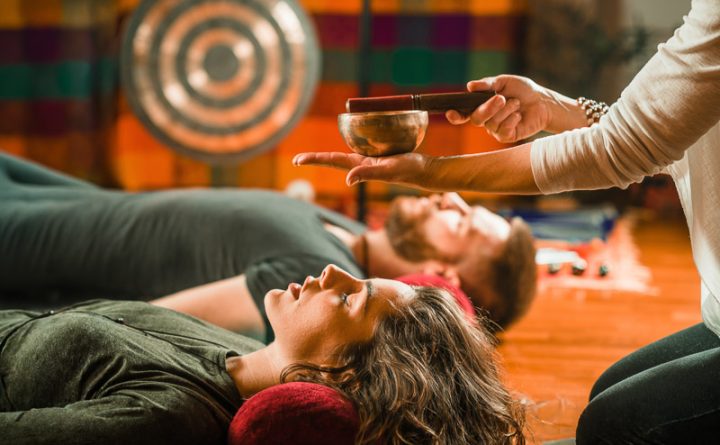
My first gonging experience was in Australia about 20 years ago. I was one of 15 people sat in a circle of chairs in a community hall. The gong players were a husband and wife team and they’d set the room up to surround us with a large selection of gongs of various sizes, made mainly of bronze or brass, and Tibetan singing bowls, the latter make an extraordinary hum when a rubber mallet is moved around the lip of the bowl.
We sat there, eyes closed as the gongmaster started playing. Before I knew it, I was enveloped in an ocean of swelling, surging and soaring sound. Using various mallets covered with soft cloth, he created a symphony of harmonics and tones through a range of strikes, swipes and strokes on the different gongs.
In one instant, the sounds are like a thunderstorm or the spatter of rain on a tin roof, the next a saxophone or a schoolboy choir. I’d never experienced anything like it. It felt like my body was being massaged inside and out by the deep vibrations. Then, the gongmaster walked behind everyone in the circle and played a singing bowl over each person’s head in turn. I melted.
Fast forward a couple of decades, and here in Ōtautahi Christchurch, gong and sound bath meditations have sprung up across town, each offering their own flavour for meditation, relaxation and healing.
What’s the attraction of being bathed in sound? For me, it was a meditation hack. I wanted to meditate, but silencing the chatter in my head – the monkey mind – was proving a challenge. Gonging is an easy way into meditation. Why? Humans are hard-wired at a primal level to respond to vibration and percussive sound.
For centuries, percussion instruments have been used for everything from calling on the gods, to going to war, inducing trance states, tribal rites, and just sounding the dinner gong.
Good vibrations
Why is gonging so conducive to meditation? Because the sounds switch the brain waves into theta state, which is the second lowest frequency band in brain activity, consequently and quickly inducing a state of spontaneous meditation.
Theta brain waves cycle at about four to seven times per second (4 Hz – 7 Hz). You are in theta state in the early stages of sleep and as you are waking up; while you’re dreaming; when you’re in periods of enhanced creativity, as well as deep relaxation.
The reason the gongs can change your brain’s wave frequencies is because there is no fixed rhythm to the ‘music’. Gong players do not play a song, melody or a recognisable pattern, so the brain quickly gives up trying to find a pattern and lets go. This allows the left, logical side of the brain to rest while the right, creative side of the brain is stimulated. That’s why gong meditation is great for creative inspiration and problem solving – because a different part of the brain is brought in to work on an issue. While the gongs will most often switch your brainwave frequencies to theta, you may also go even deeper and slip into delta (1 to 4 Hz), which is the state of deep sleep and complete relaxation. Delta brainwaves bring a number of benefits, including reducing cortisol levels, which is the hormone released by stress that can damage parts of your body.
_______________________
Sound baths for beginners
What is a sound bath?
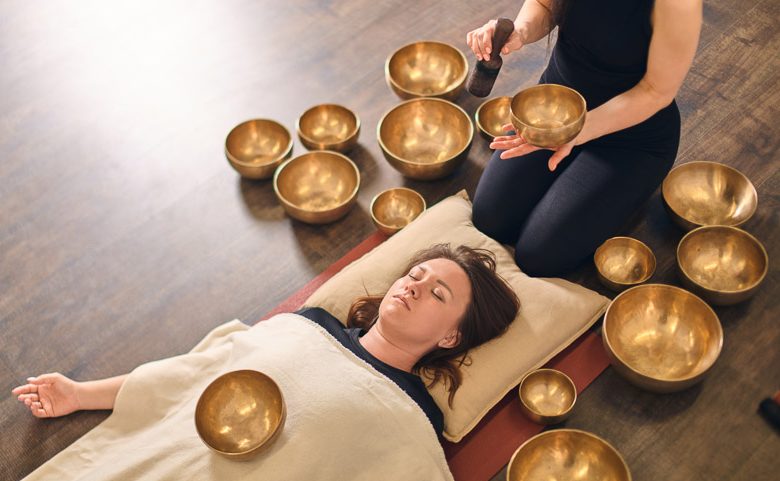
A form of meditation or relaxation that involves being immersed in sound vibration from someone playing the gongs or singing bowls. Some believe that the frequencies of these vibrations can be physically and emotionally healing. This is why different gongs are tuned to different frequencies – to work on different parts of the body.
What do I need to do?
Lie back, relax and let the gongs or bowls take you on a journey.
What if I fall asleep? It doesn’t matter, plenty of people do and you’re still getting the benefits of the vibrations. If you start loudly snoring though, someone may gently touch your foot.
What are the benefits?
The gongs or bowls quickly induce a meditative state by calming the mind and ceasing the internal dialogue. Sound therapy is used for stress-related issues and depression because it can release tension and aid relaxation, stimulate the circulatory and glandular systems, rebalance the physical and emotional bodies, and awaken higher states of consciousness conducive to healing.
I’m sold, where can I experience something like this in Christchurch?
You could start with one of these providers but also keep an eye out on events calendars and Facebook.
- Nine Healing Arts in Bishopdale, ninehealingarts.nz
- Fernanda Cecchi at holistic centre Portal I Am, portaliam.co.nz
- Papanui Spiritual Centre, papanuispiritualcentre.co.nz
- Lena Rae, lenarae.com