

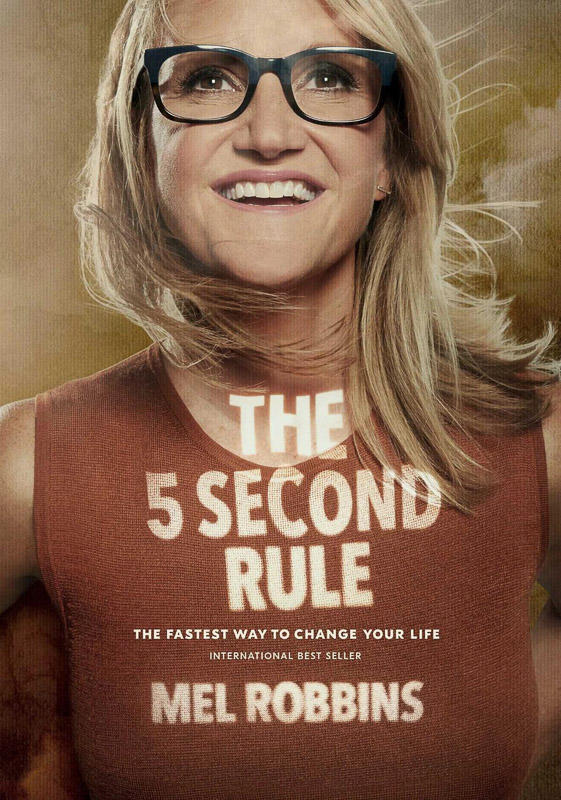
Mel Robbins’ 5 Second Rule
Five, four, three, two, one… go! Metropol deputy editor Tamara Pitelen delves into the 5 Second Rule made famous by motivational podcast sensation Mel Robbins.
Never heard of Mel Robbins? You’re increasingly in a minority, but if you’re not familiar with the podcasting powerhouse, or you need a reminder, let me bring you up to speed. Basically, Mel Robbins is the queen of self-improvement. Alongside 5.7 million subscribers on YouTube, six million followers on Facebook, and 2.4 million on Instagram, Mel’s eponymous podcast is the third biggest show in the world. She’s also sold more than 10 million copies of her books, including Stop Saying You’re Fine, The 5 Second Rule, and The Let Them Theory.
Her success is based on the typical ‘rock bottom to riches’ story. According to Mel, at age 41, she was facing bankruptcy, battling depression and drowning in debt when she discovered a simple metacognitive tool that changed her life. A year later, she delivered her legendary TEDxSF Talk titled How to Stop Screwing Yourself Over. The video went viral globally, amassing tens of millions of views. Fifteen years later, she’s built a personal development empire on the back of that idea. Here’s how Mel tells it: “At 41, I was unemployed, drowning in debt, and so overwhelmed that I could barely get out of bed. Then everything changed with one simple tool: The 5 Second Rule. It got me moving, one small step at a time, and led me here. Now, I host one of the world’s biggest podcasts, and my books have reached millions in over 65 languages. My work has changed billions of lives and can empower you too.”
What is this life-changing five-second rule? Here it is: The moment you have an instinct to act on a goal, count backwards from five to one and immediately move, before you hit zero and before your brain can stop you. In other words, when there is something you know you should do – get out of bed, make a phone call, start writing that report, go to the gym – count backwards from five to one. Then move.

The theory is that the countdown interrupts the mental chatter that usually talks us out of doing difficult things. By the time you reach ‘one’, you’ve given yourself a cue to act.
Mel says there’s a critical window between having an instinct to do something and your brain stepping in with reasons not to. She says that counting backwards engages the prefrontal cortex, which is the part of the brain responsible for changing behaviour and taking control. It interrupts the brain’s automatic habit loops, which is where procrastination, self-doubt and fear tend to sneak in. The countdown is designed to cut that process short.
The most common application is getting out of bed. Instead of negotiating with yourself after the alarm goes off, you count down and physically sit up before your brain can begin making a case for another 10 minutes under the duvet.
But Mel says it can be used for almost anything. Putting off a difficult email? Five-four-three-two-one, start typing. Avoiding a workout? Five-four-three-two-one, put your shoes on. Nervous about introducing yourself to someone at an event? Five-four-three-two-one, walk over and say hello.
The rule can even be used in reverse to interrupt habits you’d rather not indulge in – reaching for that sugary snack, or doom-scrolling social media. If you start today, will you be a global podcasting phenomenon within a decade? Give it a go and let us know. Five. Four. Three. Two. One. Go!