

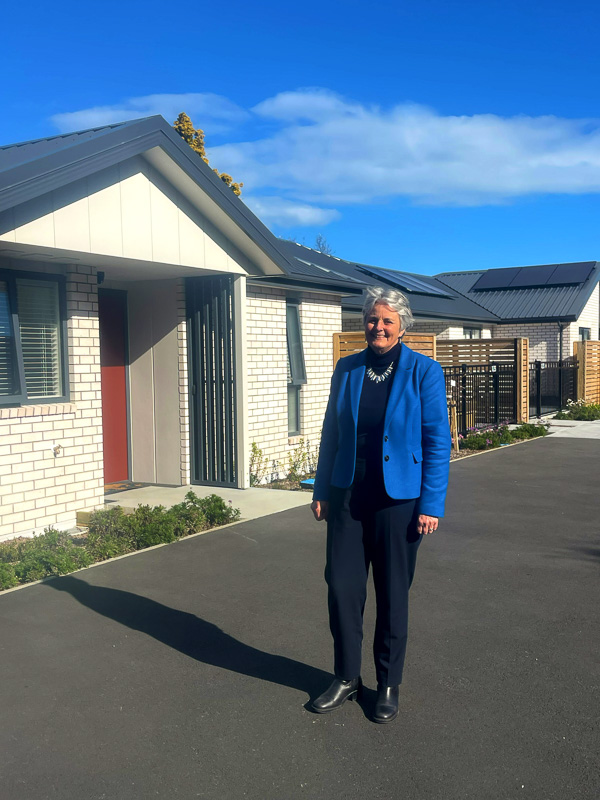
Jill’s journey with the Christchurch Methodist Mission
“How do we help people who may be struggling to flourish?” That one question has guided Jill Hawkey long into her tenure as Christchurch Methodist Mission’s executive director, writes Metropol editor Nina Tucker.
“Who are the people missing out in society? Who are the most disadvantaged or the most marginalised? What actually needs to change for them to have a good life?” Jill Hawkey’s stark delivery of reality poses a powerful question in the first few minutes of our conversation at the Mission’s Papanui offices.
I meet a lot of inspiring humanitarians in my work who make me wonder what more good I could be doing – but no one who made me ponder quite like Jill.
The Christchurch Methodist Mission (CMM) is a charity that meets the needs of an evolving community. Their work spans across Aratupu Preschool & Whānau Hub, support for tamariki, homes for rangatahi and whānau with their Housing First programme, WesleyCare’s home, hospital and palliative care, and community initiatives. Beyond the surface, the Mission does even more to wrap its arms around those who need it.
Born with a strong sense of social justice, Jill began her career as a social worker. This grew into directorships with national and international faith-based aid and development organisations. Post-earthquake, she returned to Christchurch and applied for her current role with the Methodist Mission. She admired their committed kaupapa in “asking the hard questions” and has been a fearless, dedicated upholder of that vision ever since.
What does her purpose look like in practice? Quite literally, it could be a child in need at Aratupu Preschool & Whānau Hub one moment, and a conversation about installing solar panels at a housing complex the next. Jill laughs. “No one day is the same,” she says.
To capture her immense responsibility, Jill manages a 300-strong organisation across multiple service and support sites, with everything on her plate from payroll and campaign planning to conversations with government leaders about homelessness. “The challenge is being able to keep looking strategically while also doing the day-to-day management of a large organisation,” Jill explains. “We’re scanning across what’s happening with the community, listening to our social workers, and thinking, what are the resources we’ve got to respond to this particular issue?” Thankfully, there’s a manager in place for each branch of the Christchurch Methodist Mission tree, so when Jill and her team identify an individual from the youngest in society to the oldest, there’s someone on hand to help.
COLONISATION & DISCONNECTION
Jill says it’s crucial to peel back the layers of someone’s circumstances. “You can’t work with people and hear those stories, without asking ‘what’s contributed to this person being in this situation?” Take the Mission’s Housing First initiative for example, which removes people from long-term homelessness. Jill says, “What’s led them to be homeless? Often it’s starting with colonisation, and disconnection from their whakapapa, from who they are, from their whenua, and all of that history that’s unfolded.” The second question is who in the team has the best skillset to help – and how each interaction embodies care without conditions.
“It’s really important to recognise the courage that it’s taken for somebody to take that first step,” she says, on inviting those people into a community where no one is alone in what they’re going through. These are real issues in society, Jill says, and it’s not the individual’s fault. To make that known by decision makers and national leaders, Jill says data and evidence are crucial.
“We’ve really seen that in homelessness, and so what we’re needing to do is to prove to the government that it is increasing in our community. The only way we can do that is through data and statistics – showing the numbers. It’s meant setting up a data project where everybody who comes through our front door for the first time, we ask a set of 10 questions to get a really clear idea of where they’ve come from and who they are,” she says.
‘Care without conditions’ has been a recurring principle in Jill’s journey, and is an overarching theme of the Mission’s, well, mission. Many they meet have been let down by organisations and agencies already. “If I think about the Housing First service, it’s recognising the significant trauma that many of the people who are long-term homeless have had before they get to our door, the amount of courage it takes to come through our door, and then just taking things at a pace that people want to go,” she says. “If you are still drinking significantly, or you’re still using drugs, then we aren’t going to say you can’t have a house. We say housing is a human right. Once you’re in a house, then we will support you to address those issues which are impacting on your health and your well-being, or the well-being of your family. You can’t start addressing your addiction issues while you’re living on the street. You need to have some security and a chance to settle.”
Whoever you are, whatever position you’re in or faith you believe, and whenever you seek help from the Christchurch Methodist Mission, they will take you as you are.
ELDERLY HOMELESSNESS
I gathered by now that Jill was not one to sit on the sidelines. Her work, and notable success comes down to a complete refusal to act passively. Lately, one of those big questions is the impact of elderly New Zealanders finding themselves priced out of the housing and rental markets. According to the New Zealand Retirement Commision, 40% of retirees, or 600,000 people, will be renters by 2048. The housing and rental market is increasingly unattainable for older Kiwis, and superannuation, which was designed for home-owners, no longer looks after them.
The Christchurch Methodist Mission has responded with Doors To Dignity, a campaign which aims to ensure all older people can age in a place they call home safely, and where possible, independently.
“We see a lot of elderly people coming through our doors at the moment who are totally reliant on superannuation, who have rented all of their lives. Suddenly they come to retirement and superannuation doesn’t meet the cost of their rental. What do they do?”
Consider it. A landlord charging a reasonable rent dies or sells and the new owner lifts it to a ‘market’ price. The city booms with brand new homes yet many have steep stairs and accessibility concerns. For a growing number of retiree renters, NZ Super alone doesn’t cover the cost of rental fees. “Unless you’ve got significant savings, you really are stuck,” Jill explains. The campaign will draw attention to this nationwide issue and aims to build a future where older New Zealanders can age in secure, accessible, affordable homes surrounded by a neighbourly community to foster health, financial betterment, and social connection.
HAVE YOUR SAY
The Christchurch Methodist Mission invites you to their panel discussion, Solutions to the Older Persons Housing Crisis, from 7pm to 8.30pm on 9 October.
Find your free tickets at: events.humanitix.com/doors-to-dignity-panel-discussion