
Hunting for herstory
Words by Tamara Pitelen | Images by Larnya Bourdot
Gleaned from archives, gravestones and ancient records, Roselyn Fauth has been unearthing and sharing the forgotten lives of South Canterbury women.
“When I started the blog, I was not trying to write women’s history,” says Roselyn Fauth (née Cloake). “The blog began for a very practical reason. I heard about someone’s Facebook page getting hacked, and I panicked because I had a decade of history hunting posts on mine. So I started writing them as blogs for the website, but I am not a writer, and I’m also dyslexic, so I didn’t expect anybody would want to read them. I just wrote them for me, so that I wouldn’t lose what I had done. But it turns out that people are interested. My Facebook page used to get about 20,000 to 30,000 views a month, but in January, I got half a million.”
Roselyn is the co-founder of WuHoo Timaru, a volunteer-led, local storytelling platform that began as a way to share free fun places and local gems. In 2025, gripped by the fear that countless Facebook posts might vanish, she began painstakingly rewriting them as blogs. The project quickly took on a life of its own. After publishing around 100 posts, she realised something unsettling: almost none of the posts centred on women.
“It wasn’t deliberate,” she says. “It just kind of happened.” And that, she realised, was precisely the problem.
Missing women
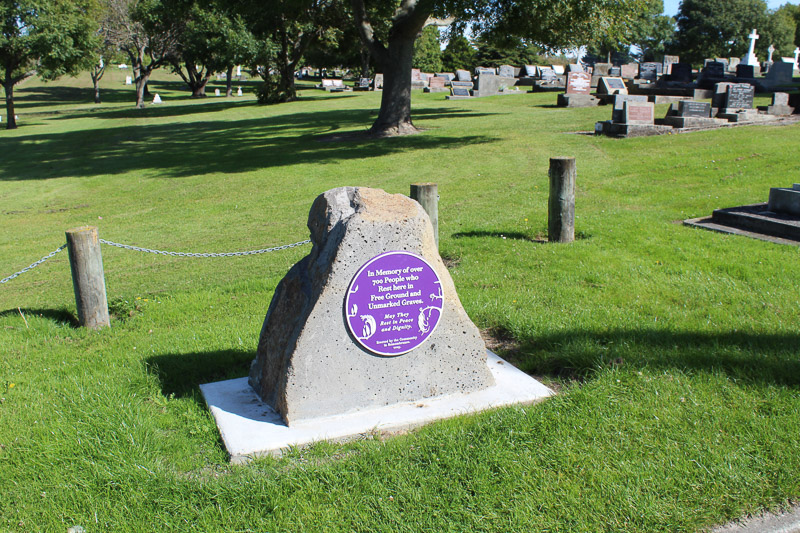
On paper, many of the women buried there barely exist. They are ‘wife of’. They are daughters, dependents. A line or two in a ledger. A passing mention in a man’s obituary.
“Their lives were side quests in a write-up about a man’s, they may have got a sentence or two in a history book, and sometimes their story wasn’t recorded at all. Their work could be domestic, unpaid, emotional, or assumed. Important, but invisible,” Roselyn says. In an effort to redress the balance, she has spent the past several years poring over archives, wills, shipping records and brittle newspaper columns to coax fuller lives from those mentions. It is, as she describes it, “an act of recovery.”
Across Aotearoa, and particularly in provincial towns like Timaru, women’s lives were often recorded in fragments. As New Zealand shifted from colony to nation, laws and economic forces shaped women’s choices in ways that are still startling to revisit. Financial depressions pushed families to breaking point. Suicide, once illegal, could mean family assets were forfeited to the Crown, leaving a widow destitute. Legislation once allowed a man to marry his deceased wife’s sister. Women gained the vote in 1893, yet decades later the marriage bar (a law requiring women in certain professions to resign upon marrying) forced many to choose between career and family. The policy also prohibited employers from hiring married women.
“The more I researched,” Roselyn says, “the more I saw that men made the laws and the choices, and women lived with the consequences.” Some stories were easy to trace. Others took a year of steady digging, aided by archivists, historians, descendants and generous strangers. “It’s been amazing to have had so much help from the community, from staff at the museum, the council, the librarians who have created the Aoraki Heritage Collection, as well as local geneologists.” It’s been a huge learning curve in reading between the lines, Roselyn says. Noticing who was being centred and who was being sidelined. Conversations with descendants were a reminder that remembrance carries responsibility.
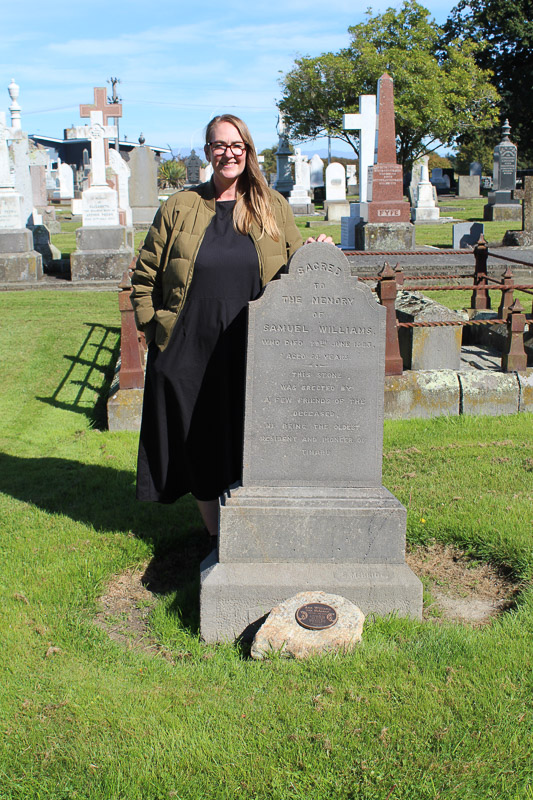
Cemetery tours
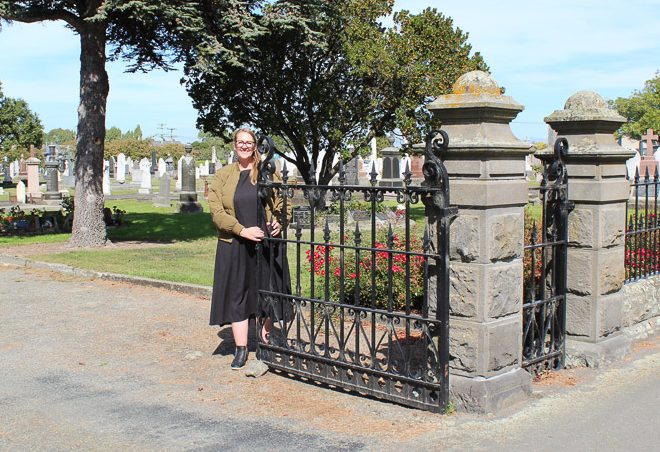
Out of that work grew her small-group cemetery tours, timed around occasions such as International Women’s Day and run as fundraisers for the Aoraki Women’s Fund. Over the course of an hour, 10 to 15 people walk through selected sections of the cemetery, pausing at graves chosen not because the women were the ‘first’ or the ‘most famous’, but because their lives illuminate something larger.
Roselyn weaves together threads of domestic labour, political reform, economic hardship and quiet resilience. She explains how royal edicts, parliamentary decisions and local industries rippled outward into kitchens and classrooms. The experience is part history lesson, part civic reflection, part community conversation.
For Roselyn, the tours are as much about the present as the past. In 2025, she was named South Canterbury Woman of the Year by the Aoraki Women’s Fund. Asked to speak publicly about her journey, she realised how little time she had taken to reflect on her own story as a half Dutch woman on her mother’s side.
“Learning about women’s history gave me context,” she says. “It helped me understand where I come from, what shaped me, what’s helped me and what’s stood in my way.”
The award deepened her commitment to the Fund, which sits under the Aoraki Foundation. Unlike one-off fundraising drives, the Women’s Fund operates as an endowment: donations are pooled and invested, generating annual grants for women and girls across South Canterbury while the capital continues to grow. The fund has surpassed $70,000, with ambitions of reaching $100,000 and, eventually, a $1 million endowment that would create a permanent funding stream for gender-focused initiatives.
Standing among weathered stones, she tells her groups that the value of the walk is not measured in kilometres. It lies in the research, the intimacy, the impact. In the recognition that when records are silent, inequities often lurk behind the silence. And in the understanding that advocacy today is tethered to memory.
“Women have always shaped families, communities and places,” Roselyn says. “Even when history failed to record them properly.”
To read the herstories of South Canterbury, or to book a cemetery tour with Roselyn, go to wuhootimaru.co.nz. Follow WuHoo Timaru on Facebook at facebook.com/WuHooTimaru.
Do you have a South Canterbury story to tell?
“People are welcome to be a guest writer,” says Roselyn Fauth of WuHoo Timaru. “I’m happy for this to be a repository for local family history (herstory), I’ll put their story up on Facebook and the website.”
While she loves telling people’s stories herself, Roselyn wants to give other people a voice as well. “The disclaimer is that we’re all just community writers, we don’t come from an institutional, research background. It’s all anecdotal, family stories that have been passed down so if anyone’s going to cite any of the information, be aware that it hasn’t been fact-checked. We’ve just done our best to preserve old stories.”
Got a great story to share? Email it to roselyn@cloake.co.nz.