

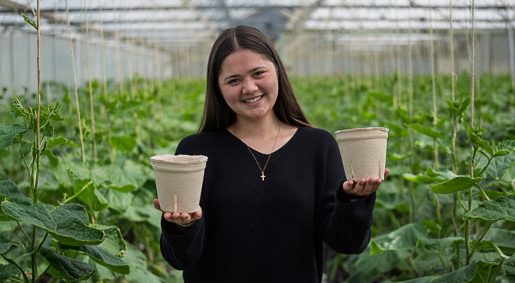
Plastic-free plant pots
A teenage entrepreneur from Christchurch is tackling one of the biggest hidden environmental challenges in New Zealand horticulture: the 350 million single-use plastic plant pots used each year.
Elisa Harley is reimagining how we grow, without the plastic. At just 19, she founded Enivo Pots, a startup turning local waste into biodegradable plant pots to tackle the 350 million plastic pots used annually in Aotearoa New Zealand. Elisa’s innovation has earned her one of the five places on the 2026 evokeAG Groundbreakers program, a world-leading agrifood technology and innovation event.
Where did your journey of product development and innovation begin?
During COVID lockdown, I’d built a greenhouse with my dad to grow native plants for sale to nurseries. The 700 or so plants in the greenhouse meant 700 single-use pots. I think anyone who has ever been into gardening can relate to the stash of plastic pots in the corner of the garage or garden. Every year, 350 million plastic pots are used in New Zealand.
To me, it seems counterintuitive that planting trees creates plastic waste. I saw what plastic was doing around the world, that it was bad, but that we had just decided to keep using it because it was convenient. When trees in plastic pots are planted on-farm in New Zealand, the chances are those pots end up in landfill because in a biosecurity concern zone, each of those pots needs to be individually sterilised, and that’s costly.
Your solution is biodegradable pots made from primary industry residue, how did you go from idea to founding the start-up?
I came up with the idea for Enivo Pots in mid-2022, and it was officially incorporated as a company a few months ago. The website is www.enivo.co.nz. In between has been everything from creating prototypes with a blender in my kitchen, research and conversations with industry professionals, through to
grant applications and collaboration with Scion Research (New Zealand’s forestry research institute), which has allowed me to refine the manufacturing process and test the product in commercial settings.
What sets your innovation apart from other alternatives?
Although there may be other biodegradable plant pots, the materials they are made from are not very sustainable, for example, harvesting peat.
In New Zealand, you can buy biodegradable pots at the supermarket, but if you need 100,000 trees, then they come in a plastic pot or plastic bag. Other alternatives are also very expensive, so my innovation is targeting large-scale commercial nursery production.
What were some of the challenges you’ve overcome?
I’ve realised that New Zealand isn’t set up for manufacturing, but I’ve been quite stubborn because I wanted my products to be made here.
What attracted you to the evokeAG. Groundbreakers program?
evokeAG in Melbourne will be an incredible opportunity to share my innovation. I also want to raise awareness about why we should be innovating for the planet. It’s not driven by a ‘woke’ ideology but because the circular economy is just pure logic. Landfills are not black holes – there is a physical space that we put our rubbish into, and as we grow, it takes up more space.