Truffle snuffle. The Waipara labradors hunting for a prized global delicacy
by Metropol | July 22, 2026 8:33 am
When winter moves in, the truffle dogs of North Canterbury get to work. Metropol deputy editor Tamara Pitelen talks to truffle dog handler Jax Lee-May about the benefits of using dogs over pigs for truffle hunting (hint: finger count) and what she learnt from police drug dogs.
On a frosty winter morning in North Canterbury, a truffle dog weaves through rows of evergreen oak trees, nose pressed close to the ground. Suddenly it stops, circles a patch of earth and looks back expectantly at handler Jax Lee-May of Kings Truffles in Waipara. Moments later, a prized black truffle is unearthed from beneath the soil.
“It’s amazing,” she says. “Every dog’s so different. Every new dog I train, I learn something different from them as well.” At Kings Truffles, near, the dogs are as important to the harvest as the trees themselves. While truffles are among the world’s most sought-after delicacies, they remain hidden underground until their aroma signals they are ripe. Finding them requires a nose far more sensitive than any human olfactory organ.
The business began with Jax’s parents, who stumbled into the truffle industry almost by accident. Her father, who had a background in farming and soil science, became involved with a property growing truffles and was asked to investigate the crop’s potential. Research trips to Australia and France followed. “He saw this amazing niche little industry for New Zealand,”
Jax says. “Being local to Canterbury, he pinpointed a few properties and areas that he thought would be really successful at growing them.”
The family’s first truffle block was established in the Waipara Gorge, and over time the business expanded into producing inoculated truffle trees for other growers. Jax initially joined as a university student, helping in the nursery during holidays.
“I started more as a holiday job working in the tunnel house,” she says. “At that stage I was doing marketing and graphic design and never really thought I’d end up here.”
After travelling overseas, she returned home and found herself helping train a truffle dog while searching for work. “I basically got hooked,” she says. “I really enjoyed it, helped create them a website and things, and then slowly decided I might make that my day job instead.”
On the nose
Growing up on a high-country sheep and beef farm meant working dogs were already part of life, but training dogs to locate truffles was something new. When she first started, Jax sought advice from police drug dog handlers. “We had a contact in the police force, and I actually went and spent a couple of days training with their drug dogs,” she says. “I got a lot of cool little tips from them.”
Since then, she has trained four truffle dogs. Choosing the right puppy starts with a simple test. “The first thing I do is sit in the middle of a litter with a truffle in my pocket and see if any of them are interested in that,” she says. “I’m looking for ones that are always searching with their nose, or ones that make eye contact with you and want to please you. All my dogs are quite needy, which is frustrating, but helps with the training.”
Like any trainer, Jax knows success depends on the time invested. One of her current dogs is nearing retirement, while another is stepping into the role of lead dog. The dogs work hardest during winter, with the truffle harvest running from June through August. “We remind people they’re a working dog for three months of the year,” Jax says. “The rest of the time they’re your family pet.”
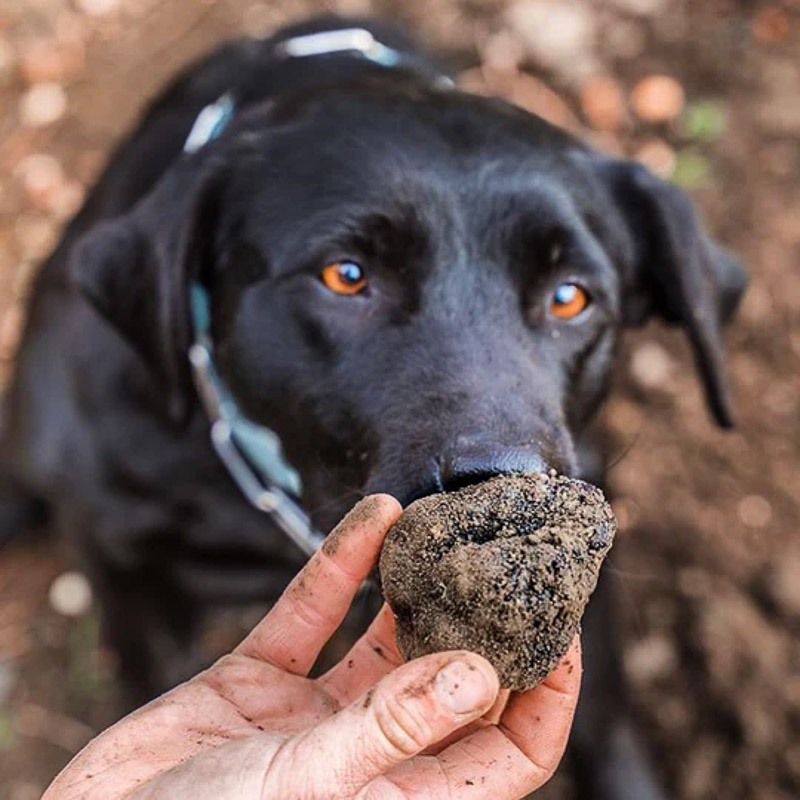
The truffles themselves are one of nature’s hidden treasures. Unlike most crops, they develop entirely underground around the roots of specially inoculated trees. At Kings Truffles, evergreen oaks are used as host trees, with the truffle spores introduced to the root system.
The truffles are there long before any human can smell them. “It’s an underground fruit,” Jax says. “The winter frosts help trigger the ripening. When it wants its spores spread, that’s when it suddenly becomes stinky and attracts all the pigs and mice and bugs and things.”
Before that point, she says, there is almost no sign that a truffle is present. “You’ll look at it and there’s just no smell. You’re just smelling a clump of dirt.”
Snouting about
Historically, pigs were used to find truffles, particularly in France. Female pigs are naturally attracted to the scent of ripe truffles, which resembles a boar pheromone. The downside is that pigs are often more interested in eating the truffle than finding it.
“When we went over to the French markets, a lot of the older truffle farmers were missing fingers.” Dogs, by contrast, are motivated by rewards rather than the truffle itself, Jax says.
“They want the reward rather than the truffle.” Once harvested, time is critical. Fresh truffles have a short shelf life, so the team carefully schedules harvesting and deliveries.
“We always aim for 24 hours from when we harvest it to when it’s sent,” Jax says. The truffles make their way to restaurants and home cooks around the country, where they are typically shaved over dishes rather than cooked directly.
“You don’t really cook with it at high temperatures,” she says. “Your kitchen will smell beautiful, but you’ll cook off all the aroma.” Instead, truffles are often shaved over pasta, risotto or beef dishes just before serving. “That’s why you quite often see chefs doing it at the table in front of people,” she says. “Part of it’s the show, but it’s also because you want to keep all that flavour there.”
Fresh truffles can sell for between $2 and $3.50 per gram, depending on quality and quantity, helping explain their reputation as a luxury ingredient.
“It’s either people love it or they don’t like it at all,” she says. “There aren’t many people that are just so-so on it.”
As production increases on newer plantings, she sees opportunities to grow the business further, including reviving guided truffle hunts that allow visitors to watch the dogs
at work.
“It’s a great educational tool. People can come out, hunt for their truffle before they eat it, and learn about something that’s still pretty new in New Zealand. “I always like the fact that it brings everyone together,” she says. “It’s a cool excuse to get out in winter, get outside and try something different.”
To be part of an upcoming truffle hunt, book through kingstruffles.com
Source URL: https://metropol.co.nz/truffle-snuffle-the-waipara-labradors-hunting-for-a-prized-global-delicacy/