The book of love: Romance author Rosie Richards
by Metropol | February 4, 2026 8:39 am
With 130 books published and 10 million copies sold in 30 countries, Canterbury romance writer Rosie Richards is Aotearoa’s most prolific author. Now based in Akaroa and contracted to produce a new book every 10 weeks, Rosie talks to Metropol deputy editor Tamara Pitelen about fear, love and romance shaming.
Rosie Richards – better known to romance readers around the world as Alison Roberts – says that the hardest part of writing is getting started. Which is why, every morning, seven days a week, she has a strict routine for getting into the right headspace and producing a daily quota of at least 1000 words.
“Writing of any form is not an easy thing to do. You have to shove yourself through the door into that space with both hands,” Rosie says. “I’ve developed a very rigid ritual. I’m up at 6.30am. I look at email and news headlines to make sure the world’s not ending, because there wouldn’t be much point working if it had. Then I do Wordle and play a game of Solitaire, or six.”
This warm-up activity triggers something in the back of Rosie’s brain, she says. “I can feel the story start to tick over in my head, and then I know I’m ready to start. Once that happens, I grab as many hours as I can in that space, because it’s twice as hard to get back into it after the first session. I read a book a couple of years ago that changed the way I work. It said that you’ve got a four-hour window to do your best work in a day, and you’ve got to protect that and not get distracted by anything. So, once I start, I try very hard to get the four hours in.”
It’s a discipline that has sustained an incredible 30-year career as one of the world’s few specialist medical romance writers, thanks to earlier training as a paramedic, and work as a cardiology research technician. Rosie is currently finishing her 130th novel, making her New Zealand’s most published author. Sales are at ten million worldwide – a number she still finds “mind-boggling”. Add libraries, second-hand sales, digital copies, and audiobooks into the mix, and her readership balloons well into the tens of millions.
Her first career, though, was teaching. As a young woman, she moved to Glasgow for her then-husband’s work, but unable to find a teaching job, she decided to write a book [wannabe authors, prepare to be triggered]. She sent the manuscript to an agent and received a contract offer from newly founded Piatkus Books within just two weeks. “I got on a train in Glasgow the next day and travelled 10 hours to have lunch with Judy Piatkus in London and then went home again.”
Thirty years later, her stories are published in more than 30 countries and 25 languages, including Icelandic, Greek, Russian and Korean. Some titles exist as Japanese manga.
FILTHY RICH AND DIRTY ROMANCE
One of the first things people want to know when they hear Rosie’s story is, has it made her rich? “No, I’m not getting rich from writing, but I’m making a living out of it. And that’s an amazing thing to do as a writer, because it’s very hard these days.”
The enduring popularity of romance writing, as well as its evolution into subgenres such as romantasy, paranormal romance, and romantic suspense, is evidence of the insatiable demand for feel-good fiction and a love story with a guaranteed happy ending. These genres flourish in hard times – during war, economic uncertainty, and pandemics. “Romance and love stories will always endure,” Rosie says. “It’s what we all want, isn’t it? To love and be loved.” And what’s wrong with that? As Paul McCartney crooned in Wings’ Silly Love Songs.
Why then are people still so condescending of romance writing when, if you added up all the category romance novels, the commercial romance novels and women’s fiction, it totals about half of all global adult fiction sales? The disdain is thought to be rooted in misogyny, gender bias, and legacy sexism that has traditionally dismissed literature produced by and for women.
“I clearly remember comments that were thrown at me decades ago,” Rosie says. “One woman said that she supposed it was one way to live out my fantasies. A man asked me if it was necessary to have part of your brain removed to write for Mills & Boon. Someone else patted me on the arm and said, ‘It’s all right dear, we know you only do it for the money’.”
Yet the genre’s popularity shows no signs of slowing down. Quite the opposite. Rosie is contracted to write five medical romances a year for Harlequin, one book every ten weeks, while also producing longer, single-title women’s fiction novels for UK publisher Boldwood Books, set in the part of France where she once lived.
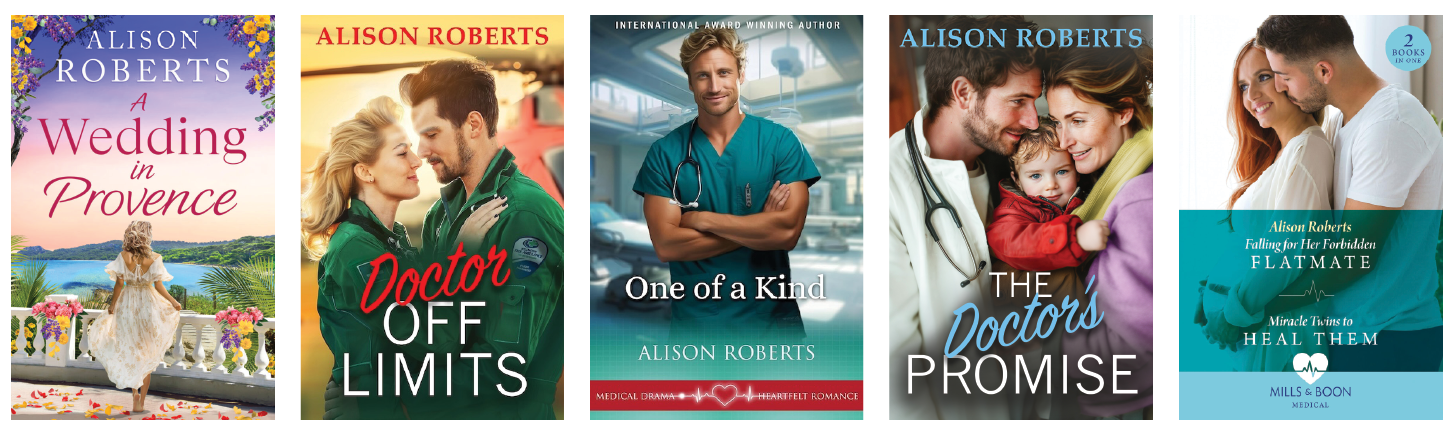
On top of that, she’s editing and re-releasing her extensive backlist, now that rights to many earlier books have returned to her. Some are being republished by Boldwood and now regularly appear in Amazon UK’s top 100 medical fiction list. One title, The Doctor’s Promise, held the #1 spot for weeks.
LA VIE À AKAROA
Her prodigious output is only possible because writing always comes first. “My workload has doubled in the last year, so writing has to be the first thing I do in a day,” she says. “Creativity is a kind of mental muscle. It responds to training and to the pressure of deadlines.”
Fear helps too, she admits. “I find fear a great motivator. The mortgage has to be paid.”
This is relevant now more than ever. In January, Rosie moved into her dream home: an 1877 cottage in Akaroa just down the road from a small forest filled with tūī, bellbirds and fantails. On her arrival, a kererū perched outside her kitchen window. A good omen. “This is my dream home. Clearly, the place I’ve always been meant to live.”
The move to Banks Peninsula is the latest relocation in a lifetime of living in different cities and countries from Glasgow to Provence. In 2016, she made the big decision to sell up and move to France, inspired in part by the Christchurch earthquakes.
“It was always a dream to learn to speak French before I died, and the earthquakes shook me up enough to realise that dreams don’t just happen. You’ve got to go out there and make
them happen,” she explains.
“I discovered that medieval France was the home of my soul, but New Zealand is the home of my heart. I intended to split my life between the two countries, but then Covid arrived, and the world changed. Plus, I got a lockdown puppy, and that made it impossible for now.” Akaroa provides the best of both worlds.
As for her personal life, she has an “exceptionally talented” daughter, Becky Richards, who is a rising ceramicist based in Auckland. She has fiercely loyal friends and a 98-year-old father, who is her biggest fan. She dedicated her first women’s fiction novel to him, “for the gift he gave me as a child when I sat with my brothers in front of a gas fire in a Dunedin house, listening to him reading aloud The Hobbit and then the entire series of The Lord of the Rings.” The dedication reads, ‘For my dad, who showed me that magic can lie between the covers of a book.’
Rosie Richards’ next book, under her pseudonym Alison Roberts, is called ‘A Wedding in Provence’ and is out on 12 February in time for Valentine’s Day. See her website at alisonrobertsromance.com.
WANT TO WRITE ROMANCE?
Check out the Romance Writers of Canterbury, which is the local chapter of the national Romance Writers of New Zealand. The group meets in Opawa on the first Sunday of every month. romancewriters.co.nz
Source URL: https://metropol.co.nz/the-book-of-love/