National treasure Gavin Bishop
by Metropol | May 13, 2026 8:40 am
Multi-award-winning children’s book writer and illustrator Gavin Bishop is a man who enjoys Zumba and can trace his whakapapa back to Māori royalty. On the cusp of his 80th birthday, he spoke to Metropol deputy editor Tamara Pitelen about life, art, and cheese scones.
“It is a very strange experience, turning 80 and slipping into that decade,” says Gavin Bishop (Tainui, Ngāti Awa), Christchurch-based, award-winning children’s picture book writer and illustrator of more than 70 books.
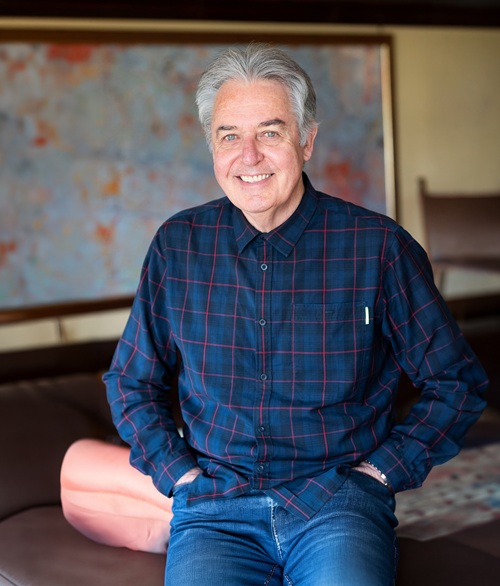 “I’m not terribly excited about it,” he continues, musing on the imminent milestone. “It sort of indicates, you know, the end is not far off. I mean, how much longer can you expect? You’re not supposed to live on forevermore, but that said, I feel perfectly alright.”
On the day we speak, it is exactly one week before Gavin’s 80th birthday. We are chatting in the studio where he spends his days writing and painting. It’s a room at the bottom of his home on Cashmere Hill. Built in 1915, it is a beautiful house of high ceilings and elegant wooden features that Gavin and his wife Vivien bought in 1969. They met while studying fine art at the University of Canterbury. Back then, the couple paid $11,000 for the house. Family and friends told them they were crazy to spend so much when the average house price then was $4000. But I digress.
For more than four decades, Gavin has shaped the visual and literary imagination of generations of Kiwi children, creating books that are read in classrooms, libraries and homes here and around the world. They comprise Māori myths, European fairy stories, nursery rhymes and original works.
Apart from all that, Gavin is a man who enjoys weekly Zumba, whose appreciation for a quality cheese scone borders on the spiritual, and who can trace his whakapapa back to the first
Māori King. We’ll get to that. First, let me attempt to summarise his frankly ridiculous list of achievements.
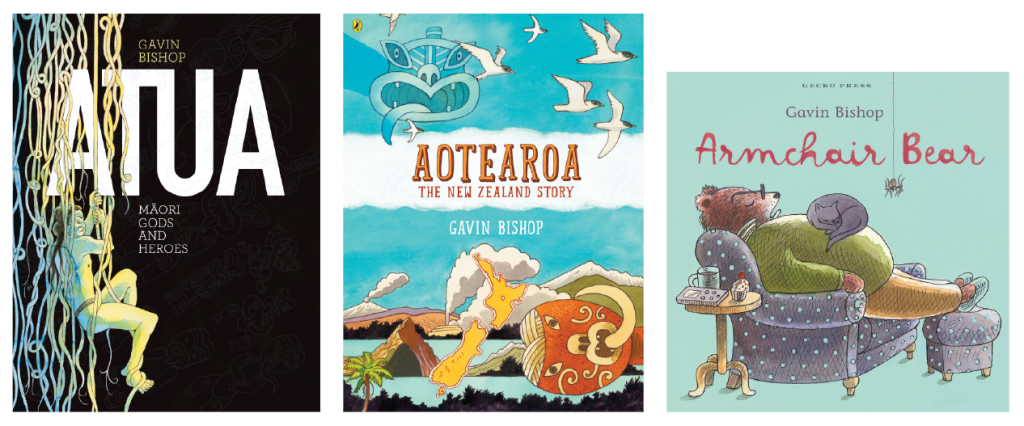
Gavin’s work has been translated into multiple languages, adapted for stage and screen, and recognised with almost every major honour in the country’s literary and arts landscape, including the Prime Minister’s Award for Literary Achievement, the Storylines Margaret Mahy Medal for lifetime achievement, and the prestigious Sir Kingi Ihaka Award for his contribution to Māori art. In 2013, he was named an Officer of the New Zealand Order of Merit (ONZM) for services to children’s literature. He has an honorary doctorate from the University of Canterbury, and the establishment of the Storylines Gavin Bishop Award in his name underlines his influence. He has won the supreme Margaret Mahy Book of the Year Award a record five times – most recently in 2022 with his Atua: Māori Gods and Heroes, which also won the Elsie Locke Award for Non-fiction and the Russell Clark Award for Illustration. I could go on. Basically, as far as I’m concerned, the man is a national treasure. I don’t know who decides these things, but if there is a list somewhere, let’s get his name added and make it official.
Southern man
While we now (quite rightly) claim Gavin as a Cantabrian, he was actually born in Invercargill in 1946. The 1950s and 60s New Zealand that Gavin grew up in still looked to England for its cultural references.
“When I was a kid at school, most of the books we had were from England. A couple from Australia and America, but very, very few from New Zealand. So, we just took for granted that it snowed at Christmas time with robin redbreasts, and we talked about meadows and fields, not paddocks. That kind of thing. We completely denied our own reality. We still do.”
Gavin’s career can be seen, in many ways, as a corrective to that disconnection. Since publishing his first book in the early 1980s (about a brave sheep called Bidibidi), he has worked to centre local stories, landscapes, and identities. Discovering his own Māori ancestry later in life has also influenced his passion for telling the stories of Aotearoa. Like many New Zealand families, his whakapapa had been partially obscured – fragments of identity lost or unspoken across generations.
“I knew that my granddad, Benjamin Mackay, had been born in Port Waikato in the 1840s. He was just a young guy when the wars in the Waikato started.
“His father was a Scotsman, and his mother was Māori. Her name was Irihapeti Te Paea Tīaho Te Wherowhero, and she was the oldest daughter of Te Wherowhero, who later became Pōtatau Te Wherowhero, the first Māori King in 1856,” he says.
“As a child, I knew nothing about this. We knew that grandad was Māori, but we didn’t know anything about the family. It was only when my brother and I decided to make a trip up to the North Island in the late 80s that we found out more. We went to places where we thought there might be relatives. Sure enough, we came across dozens. Dozens! We kept meeting these elderly people whose grandparents had been brothers or sisters of our grandfather. It was very interesting. It was very moving. And it resulted in a family reunion at Port Waikato in the early 90s. Hundreds of people turned up. Some people were completely Māori, whose first language was Māori, and there were white people who had never had anything to do with Māori, but we were all quite closely related. I thought it said a lot about New Zealand. That’s what New Zealand is. It’s like that sort of funny mixture. It’s made me more focused on writing and illustrating stories that reflect this part of the world.”
Sheepish beginnings
Gavin’s entry into children’s literature was accidental – sparked by a chance conversation in 1978 with a fellow teacher and a call for distinctly New Zealand stories from Oxford University Press (OUP).
“I met this person out of the blue while in Dunedin for a stint as a school art advisor. She told me that her son was working for Oxford University Press in Wellington, and they were looking for children’s books to publish that had a strong New Zealand flavour. I thought ‘wow’. And this woman said to me, ‘Why don’t you have a go at something?’ So I started writing my first book that night in the pub where I was staying. I had no idea what I was doing. I didn’t even know that a picture book had a limited number of pages, you know, 32 pages. I knew nothing about that. So I started writing this book about a sheep. I thought that would be a good character because in those days, we had a lot of sheep.”
That first book was called Bidibidi, the story of a high-country sheep who goes in search of a better life. Although it had a slow start, eventually the book became a huge success and was made into a local television series called Bidibidi to the Rescue.
Getting Bidibidi written and published was a massive learning curve for Gavin. He was guided through a painstaking editorial process by mentor Wendy Harrex of OUP, who taught him the fundamental principle of picture books: economy.
“’Leave out all the descriptive stuff’, she advised. ‘You can put that in the picture.’”
Gavin learned to strip language back to its essence, allowing images to carry the narrative weight. “Most of what I do is about what you leave out,” he explains. This approach is being tested once again in his latest project, a sweeping visual history of ancient Aotearoa spanning many millions of years – condensed into just 64 pages. The challenge lies not in finding material, but in distilling it. “What do you leave out?” he repeats. The process involves deep research, consultation with experts, and an almost obsessive mental engagement. Ideas surface at all hours. “I was up at 3am last night… writing things down.”
For the last decade, he has worked closely with publishers such as Gecko Press and Penguin Random House, Gavin has shifted from generating his own ideas to responding to ambitious commissions like the previously mentioned history of ancient Aotearoa he’s now working on.
Recent work also includes a new book, the soon-to-be-released Armchair Bear, about a sedentary daddy bear who gets his mojo back. Gavin’s career, which began alongside a 20-year stint teaching art at Linwood High School and later Christ’s College, only became full-time in 1999. Leaving teaching in his fifties to become a full-time writer and illustrator was a risk, but one that paid off. “I wanted it to be a career, not a hobby,” he says.
At 80, Gavin Bishop stands as one of Aotearoa’s most influential storytellers – not because he has all the answers, but because he continues to ask questions about our history, identity, and how best to tell a story in carefully chosen words and images. Perhaps most importantly, asking questions about what really matters enough to include – and what we can leave behind.
Quickfire with Gavin
Coffee or tea? Tea. Standard gumboot with milk no sugar. Just one a day, in the morning. I really feel the effects of that cup of tea.
What’s a typical morning? Three mornings a week, I go to the gym to do a class. I used to love Zumba, but the person who now teaches doesn’t do Zumba. And I used to like step aerobics, loved that, but now we’re doing a kind of Pilates. We do weights, stretching and lots of balance. I suspect it’s sort of elderly-oriented. At a dance studio down in Sydenham.
She’s nice. She’s a good teacher.
What time do you start work? I usually start at about 9am and finish about 4pm. But that doesn’t mean to say that Vivien and I don’t jump in the car and go off and have cup of coffee and a cheese scone somewhere.
Cheese scone? I love a cheese scone. I’ve narrowed the best cheese scones in the city down to three places – Rhodes, the convalescent home that’s near us, cheese scones to die for. Fabulous! The next best ones are at Prima, a coffee roastery on Brougham Street. They do superb coffee, and the most amazing cheese scones. One with pizza cheese and stuff sprinkled on top. The next cheese scone that I found was in Tūranga, the library café. They’re brilliant. A cheese scone should be crunchy and not too deep, but really crisp.
Source URL: https://metropol.co.nz/national-treasure-gavin-bishop/