Margaret Chapman: A life of impact
by Metropol | April 15, 2026 8:33 am
Words: Tamara Pitelen | Images: Aoraki Foundation and RWNZ
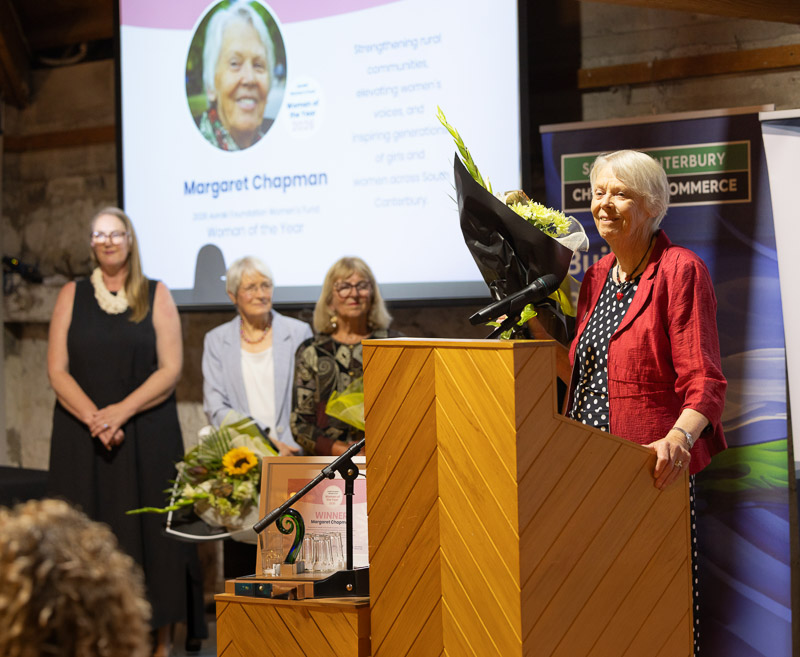
A city girl who turned country, Margaret Chapman of Geraldine, is this year’s Aoraki Woman of the Year. From protesting on the steps of parliament to organising farm safety seminars, the award recognises her five decades of passionate advocating for the rights of rural women.
In 1978, about six weeks after getting married to her husband Graham, a farmer, Margaret Chapman found herself sitting in a hall in Kākahu at her very first meeting of Rural Women New Zealand (RWNZ). She had been brought along by her mother-in-law and sister-in-law. It was an introduction to neighbours, and, as it turned out, to a lifelong calling.
“It was an opportunity to get to know the neighbours and become part of the community,” Margaret says. The meeting itself was a surprise. Formal, structured, and long. “It started at half past seven, and I didn’t get home till half past eleven,” she says. “I did think, what is this?”
The sense of connection, though, kept her coming back. “It was the women who were in that group that made it worthwhile,” she says. “We had members from 80-year-olds down to 20… we were all just accepted. Everybody supported each other.”
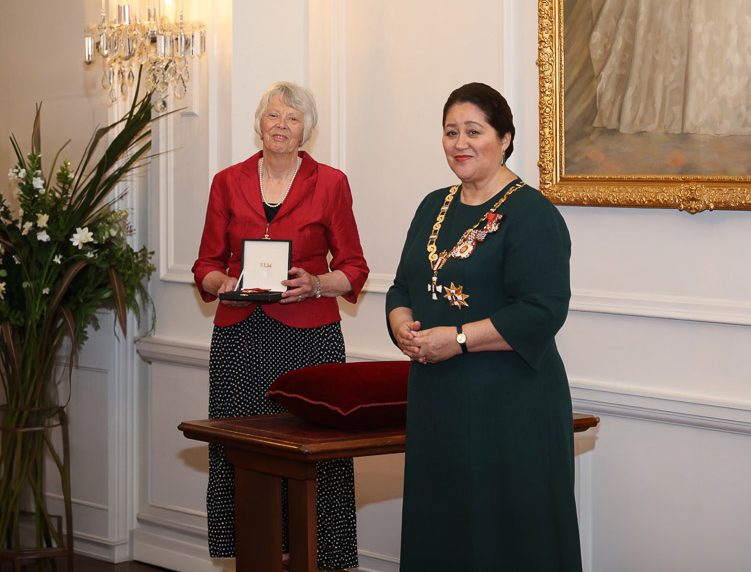
That sisterhood connection would shape Margaret’s life for the next 48 years as a vocal advocate for the rights and welfare of rural women. In 2021, her service was recognised nationally when she was appointed an Officer of the New Zealand Order of Merit (ONZM). Her latest accolade, though, is receiving the title of Aoraki Woman of the Year 2026. True to form, she is quick to share the credit.
“I don’t do it on my own,” she says. “None of the things I’ve done I’ve ever done on my own. We do it as a team, a team of lovely women who feel the same way as I do.”
A passion for equity
Margaret’s passion for rural communities was not something she was born into; rather something she discovered.
“I didn’t grow up rural,” she explains. “My mother was a farmer’s daughter, but I grew up in the city, and I was a schoolteacher.
I travelled, then came home and got married, which was when I moved out to the country.” That is when the contrast between city life and rural life for women became clear.
“I looked at all the things I could have still done in the city, which I couldn’t do out in the country,” she says. “Women were missing out on so many things.”
That realisation became the driving force behind decades of advocacy. “Trying to give rural women the same access to services, opportunities and choices that city women get,” Margaret says. “That’s what it’s about.”
Health, in particular, remains a persistent concern. “Health is always an issue in rural areas. We weren’t getting access to the same health services… and we’re still there.”
Margaret recalls advocating on these very issues decades ago – standing on the steps of Parliament to push for better support for home care workers who had to travel long distances to reach rural patients but were not getting enough money for fuel costs. “We were doing that 20 years ago,” she says. “And we’re still talking about it today. We’re back here.” For Margaret, equity isn’t some abstract policy; it’s the lived reality of whether someone can see a doctor without hours of travel, access medication locally, or receive care in their own community. Rather than wait for things to change, Margaret has spent her life helping to create change.
“I said, why is it not happening? Let’s try and make it happen,” she says. That mindset led to initiatives like the Fairlie seminars, which she helped run for 20 years, bringing a range of speakers and ideas into rural South Canterbury. “They weren’t getting any of that stimulating stuff,” she says. “I wanted it locally.”
It also led to practical programmes like farm safety education days for children, developed in partnership with ACC and eventually rolled out nationwide. “We started in South Canterbury and then went right around the country,” she says.
Her work has spanned every level of RWNZ – from grassroots to national leadership, including three years as national president.
“Something I am really proud of is the establishment of the RWNZ Business Awards in 2009, which is still going strong. The aim was to recognise rural businesswomen who overcome many obstacles to have a successful business. There are so many rural women working quietly away on some amazing small businesses. They certainly need to be celebrated.”
Connection, then and now
While Margaret has seen significant change over nearly five decades, one concern stands out today: the growing isolation of rural women.
“In the early days, we’d go to monthly meetings,” she says. “You’d sit down and talk about everything – practical things, life things.” Now, those conversations often happen online, she says. “When I first started at Rural Women, for the first half hour of the meeting, we had some wonderful older members who would answer all the questions that younger members like me would ask, ‘how do you feed a sick lamb?’ or ‘what do you feed the shearers?’ We would talk about those things, and got good, practical support.
“Now I see women asking all the questions that we did, but they are doing it in the isolation of the home, on the computer or a Facebook group, so they’re not getting the connection, the personal contact, which is so important.”
For Margaret, that loss of connection matters. She worries that as fuel prices rise and travel becomes more difficult, it will mean more dispersed communities, further weakening connections at a time when they are most needed.
Onwards and upwards
At 75, Margaret isn’t slowing down. “I’ll just carry on doing what I do,” she says. While most of her work is done through the RWNZ, she also volunteers with Meals on Wheels, at a second-hand clothing shop, for the Geraldine Historical Museum, and through community groups like the Geraldine Lioness club. “It’s about helping where you can,” she says.
When she was notified of her Aoraki Woman of the Year award, Margaret accepted it not for herself, but on behalf of Rural Women New Zealand, which celebrates its centenary this year.
“For all the work that those women before me have done,” she says. “RWNZ has always adapted to meet the changing needs of all women who are rural at heart.” It’s a fitting reflection of a life defined by service.
___________________________
100 years of Rural Women New Zealand
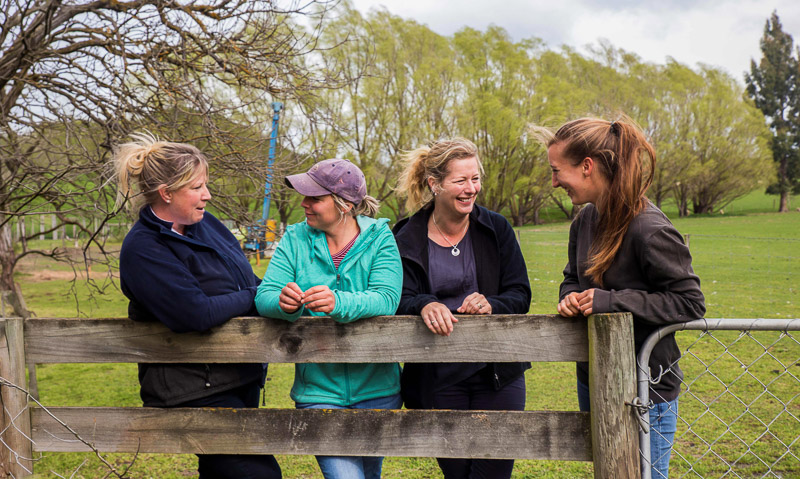
Founded in July 1925 by 16 women in a search for community and friendship and to improve support for rural women, the Rural Women New Zealand (RWNZ) – formerly the Women’s Division of the Farmers Union – has championed rural women and their communities across the country for 100 years. Over the decades, membership flourished and by 1960, the group had more than 30,000 members.
To mark the conclusion of the centenary year,
Her Excellency the Governor-General, Dame Cindy Kiro, GNZM, QSO will host a morning tea at Government House on 24 July 2026. In South Canterbury, a gala dinner will be held on 27 June in Timaru called ‘Going out with a bang.’ Other events are being held in celebration across the country.
Find out more at ruralwomennz.nz.
Source URL: https://metropol.co.nz/margaret-chapman-a-life-of-impact/