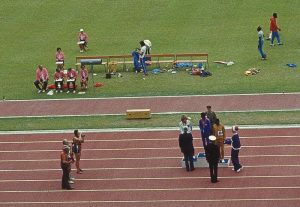
The 1974 Christchurch Commonwealth Games put our city on the world stage, and early next year we celebrate its 50th anniversary.
The “Friendly Games” games was an event that, even after five decades, is still fondly remembered by many.The smallest city, to this day, to host the games, made big waves charming the rest of the world. Between January 24 and February 2, 1974, Christchurch hosted 38 nations, 1276 competitors, and awarded 374 medals. Christchurch was the first games to highly prioritise the safety of its athletes and spectators. Police surrounded the athletes’ village, nestled inside the student accommodation at the University of Canterbury. Christchurch was also the first to ask for commercial advertising to be allowed, and thus the first Commonwealth Games to conjure a sponsoring profit.
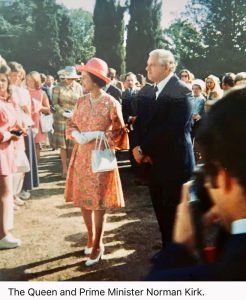
In her namesake park, the late Queen Elizabeth II attended the 1974 games. Prime Minister Norman Kirk and the late Prince Phillip were also present, along with King Charles and Princess Anne.
On Friday 26 and Saturday 27 January, Te Pae will hold two events of connection and celebration, attended by former and current athletes. The New Brighton Museum will, for five weeks, display an extensive collection of memorabilia to mark the games. Wayne Hawker, president of the museum, found himself amazed at the amount of generous Cantabrians donating or loaning their Commonwealth Games collectors’ items to the museum. “We have shoes, a cheese board, a cigarette lighter, tie pins, cups, stickers, posters, and it’s amazing the amount of stuff, and you think, ‘Why did they even do things like that?’”
Starting 13 January, the museum will fill its cabinets with Commonwealth Games paraphernalia, from autograph books holding medal winners autographs, to the official pillow where each medal sat before being awarded on the podium. The 25 pounder field guns that saluted the late Queen Elizabeth II, and a 1973 Holden Kingswood which ferried athletes and officials will also be on display.
On 28 January, gold medal winner Dick Tayler, and others involved at the time of the games, will speak at the museum’s commemorative function. “We are going to showcase just how much the Commonwealth Games meant to Christchurch, and the special bond it still holds for us,” says Wayne. At the time of the games, Wayne was 16, and his bike route to work took him past competitors on their morning runs each day. “That’s something that I’ll remember forever,” he says.
The games logo, designed by then Christchurch-based Scottish migrant Colin Simon (deceased), is still one of New Zealand’s most recognisable and iconic logos. His simple yet complex design, captures five distinct elements: the country location, the year and the games number (the Roman numeral X for 10th dissects diagonally), the colours mirror Great Britain’s Union Jack flag, while
Māori heritage is represented by stylised Vs used in carvings.
A helping hand
During the opening ceremony, over 2500 school children invaded the field wearing white, blue, and red ponchos and hats. Together, they formed an immensely-sized NZ74 logo, the symbol famously associated with the Christchurch Commonwealth Games. Approximately 35,000 spectators watched on as the children used their colours to synchronise the logo. Lynley Tucker, attending Wainoni Primary School at the time, was wearing a blue poncho and hat, and still remembers the elation on the field today. “It was very exciting. I can’t remember what we did before or after, but I remember running on and being so excited,” she recollects. The chaos of so many children, naturally, ensued. “Amongst all the blue, there was one kid in white, who got lost and ended up in the wrong area,” Lynley added. A postcard of memorabilia kept by her mother Eileen Lewis after 50 years (pictured), shows the schoolchildren in their colours.
I remember…
Warwick Burke – New Zealand Broadcasting Corporation announcer: “I was an announcer in the New Zealand Broadcasting Corporation in Christchurch at the Commonwealth Games. 3ZB had a temporary studio by the restaurant at Ilam’s Canterbury University, where many of the athletes were easy to approach for interviews. I also shot photos from the Press Box at the stadium on the closing day of the games.”
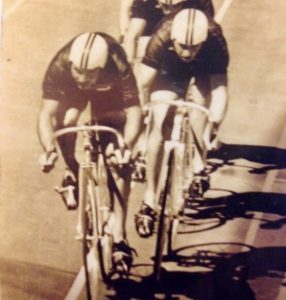
René Hyde – Track cyclist winning bronze in the Team Pursuit: “I was 19 at the time. Our events were held at the Denton Park Track in Hornby. I started bike racing at 17 and made it to the top in two short years. I rode in the Team Pursuit where we got a Bronze medal. I also rode in the 1000 metre Time Trial where I finished 4th missing out on a medal by a fraction of a second. I retired from cycling after the Games having achieved my childhood dream of wearing the fern.”
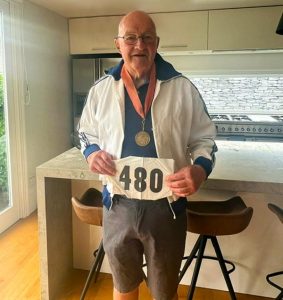
Dick Tayler 10,000m gold medal winner: “The Games being held in New Zealand was a huge plus for me, it was what motivated me. The 10,000m was on the first day of track and field and I just happened to hit the right buttons on the right day. It was the first ever sporting event [broadcast] in colour, too. Being in the Games before, I hadn’t really got the chocolates. This was payback time.”
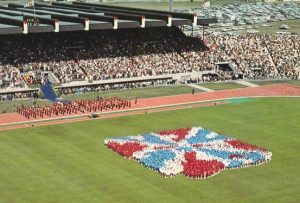 The chaos of so many children, naturally, ensued. “Amongst all the blue, there was one kid in white, who got lost and ended up in the wrong area,” Lynley added. A postcard of memorabilia kept by her mother Eileen Lewis after 50 years (pictured), shows the schoolchildren in their colours.