Canterbury’s Michelin men
by Metropol | July 8, 2026 8:37 am
A Michelin star each for two iconic restaurants, and a special Young Chef award… meet Canterbury’s Michelin men.
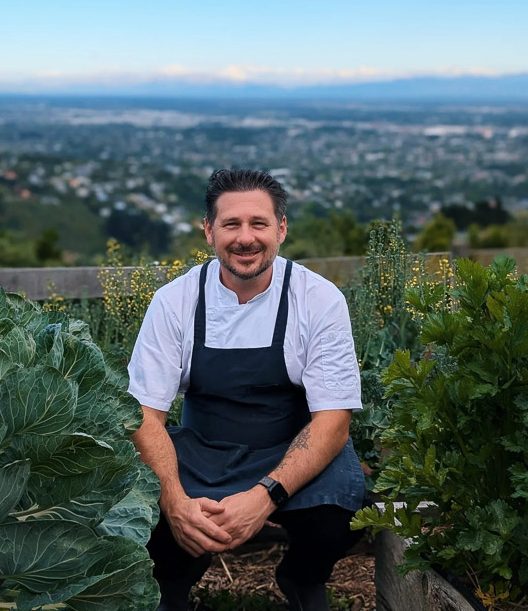
Adam Harrison, head chef and forager
Tussock Hill Vineyard and Cellar Door Restaurant – Awarded Michelin Star,
210 Huntsbury Avenue, Cashmere
One of only two Christchurch restaurants to ever receive a star from the Michelin Guide, Tussock Hill is a boutique vineyard specialising in organic wines and a restaurant with sweeping views, a rural retreat and a curated lunch-only menu featuring ingredients foraged locally by head chef Adam Harrison.
Originally from the United Kingdom and now settled in Aotearoa, Adam found his passion for wild food while exploring the English countryside as a six-year-old boy, picking wild blackberries with his grandma and collecting elderberries for his granddad to make elderberry syrup, a traditional cough medicine. By 14, he was foraging alone and learning the basics of the botanical and seasonal knowledge that underpins certified foragers.
“Foraging is like learning the seasons of produce that you buy, but there’s more levels and depths to it. It’s learning rhythms, just like you learn the seasons of your vegetables,” Adam says.
“Some chefs forage delicate herbs for their garnishes but we go layers deeper. For example, we’ve got acorns we process into flour, and we foraged about 100 kilograms of apples this year.
We did some baked apples for pies, some smoked apples, some apple juice, and we made our own verjus from crab apples. We’re looking at deeper levels of plants that people perhaps don’t know are edible, and they take a bit of processing and preserving.
“Foraged ingredients bring complexity to our dishes because commercially grown produce is often bred for sweetness, whereas foraged ingredients tend to be more bitter. For example, we’ve got a dandelion root ice cream that’s bitter, malty and delicious that sits alongside raspberry and cheesecake. It’s simple, but it adds a depth of flavour to the dishes.
“Christchurch is fortunate to be surrounded by diverse regions of foraging. We’ve got all the coastal stuff like native beach spinach, native ice plant, beach mustard, and then we’ve got the red zone, which has got everybody’s fruit trees. We’ve got a whole selection of herbs that were introduced by Chinese and European settlers, and we’re just 45 minutes away from Mount Thomas where you’ve got native bush with traditional Māori herbs such as kawakawa and horopito. Then Banks Peninsula with its different micro areas where we can forage and produce something different. That what’s special about foraging, because people are trying things they’ll probably never try again, never do for themselves. It’s giving people an opportunity to come and experience our world of foraging.”
_______________
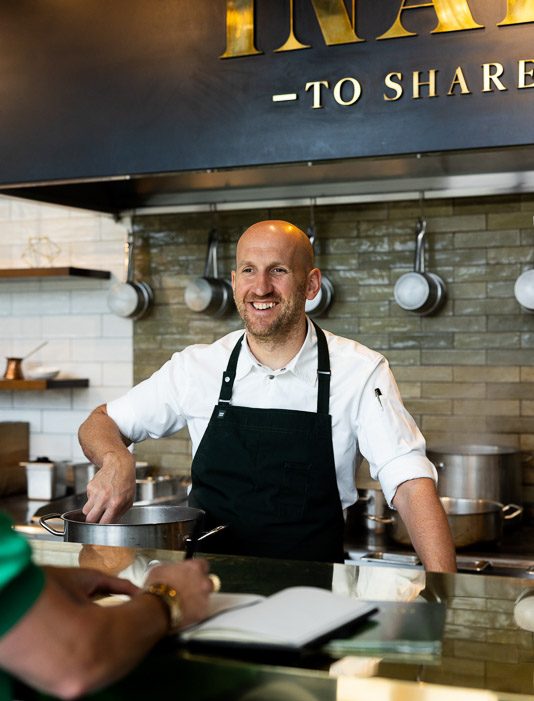
Simon Levy, head chef and co-founder
Inati – Awarded Michelin Star,
48 Hereford Street, Christchurch
One Michelin star and two Cuisine magazine ‘hats’ under his belt, chef Simon Levy of Inati is one of Christchurch’s most celebrated culinary pioneers, known for championing locally produced, seasonally-driven dining in the heart of the city.
From duck liver trumpets (which look just like the frozen sweet treat but taste like a smooth savoury sensation), to his intricate plates designed to reflect the natural environment, Simon’s name – and lucky for some, his food – is on everyone’s lips.
After decades of success in England’s hospitality industry, including time under British celebrity chef Gordon Ramsay (whose restaurants currently hold eight Michelin stars), and at London’s oldest restaurant, Rules (where the pair met in 2005), Simon and front-of-house leader Lisa (hailing from Hawke’s Bay) took a holiday to Christchurch – but it felt like home. They saw potential. Inati was a leap of faith. “We’re 12-and-a-half years on, and I don’t see myself leaving because the sky’s the limit at the moment, especially in Christchurch.
There’s not many chances where you get to be a part of that rebuild. We’re still moving forward, still evolving,” he says.
When he’s on the other side of the chef’s table, all Simon wants is good food. “I just want tasty, great food. That’s what I’m excited about.” That’s why he says ‘fine dining’ is interpretive. At Inati, local partnerships and produce are at the heart of each plate.
“We wanted to showcase Canterbury in all its glory,” Simon says, talking with Metropol tableside at Inati. The menu changes with the weather, where produce reflects what’s readily available in the region. “We want to showcase what’s happening in real time. My style is highly interactive and exciting. I get to be creative with some fantastic produce.”
That philosophy underpins how he feels about winning a coveted Michelin star. “It’s an amazing way to advertise this city on a global scale.” Not just for what it does for Christchurch’s hospitality industry, but how it ripples through the city on a whole.
“They’re going to stay in a hotel, they’re going to get a coffee somewhere. They’re going to go to a novelty store and buy a stuffed sheep or an ‘I love Christchurch’ tee shirt,” Simon says. “It’s the same hospitality that this city gave me when I got here and made my decision to stay easy.”
________________
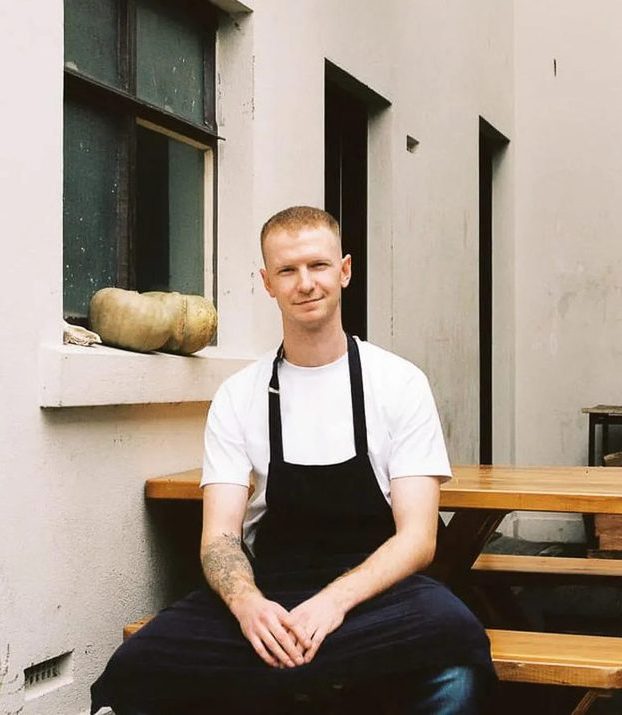
Bob Fairs, head chef and founder,
Michelin Young Chef award winner
Londo, 6/2 Papanui Road, Merivale
Robert ‘Bob’ Fairs won one of three special awards presented at the first-ever Michelin ceremony in New Zealand. The Guide recognised Bob with the Young Chef Award, while naming his wine bar turned restaurant Londo in the Bib Gourmand selection.
Bob has been “infatuated” with food and cooking since childhood, learning at his mother’s side as she baked, while he was “messing around with off-cuts of quiche or whatever she was making.” In adulthood, he’s become of Christchurch’s best chefs, and he’s only 30. Age 15 and looking to make some money to buy records, he got an after-school job washing dishes at the Cassels Brewery restaurant. After two weeks, celebrated chef Finbar McCarthy “pulled me out of the dish pit and got me cooking.”
He worked his way through kitchens, and then in 2015, Bob left Christchurch to intern in a restaurant in Copenhagen when new Nordic cuisine was all the rage. “I saw [Gatherings founder] Alex Davies and told him what I was doing, and I remember him very clearly saying, “awesome, bro, but bring it home.”
He returned to an influential stint as head chef at Lyttelton’s Roots with Guilio Sturla, who now runs Mapu, spent some time cheffing in Dubai, before cementing his culinary craft in Christchurch with Londo, which was born to showcase the organic and low-intervention wines he loved and whose makers he was friends with. The serious cooking chops of the young chef gained the small space on Papanui Road a reputation for thoughtful and delicious food, and now he says, “the market dictates what you are, and we have become a restaurant, people treat us as a restaurant, and that’s a great thing.”
Bob talks of the relationship between food and its location; how in Christchurch that means “you can get the best of the South Island to your door within a day or two. You can get the best lamb from Southland or kina or paua from Bluff, you’ve got all these amazing orchards and vineyards up in Nelson and Marlborough, and we really pull predominantly from the South Island,” he says. “Because for my generation, at least, using the best product isn’t a flex or a point of difference anymore. It’s an expectation.”
What to expect from Bob at Londo? He gives the growers and their ingredients most of the credit, but he consistently wows diners with designing a dish from a few key ingredients and then works backwards. The menu changes every six to eight weeks, and Londo is famous for never repeating a dish.
londo.bar
________________
HISTORY OF THE MICHELIN GUIDE
It began as a way to promote road trips by tyre manufacturers. Now the Michelin Guide is recognised as the global benchmark for fine dining and the hospitality industry’s version of the Oscars.
Founded in 1900 in France by tyre manufacturers André and Édouard Michelin, the Michelin Guide began as a promotional booklet designed to encourage road trips, thereby boosting car usage and, ultimately, tyre sales. Today, it is the last word on fine dining.
In 1900, there were fewer than 3000 cars in all of France. To increase demand, the Michelin brothers distributed 35,000 free copies of a pocket-sized guide to motorists. It included vital information for early travellers, such as maps, tyre-changing instructions, locations of mechanics, fuel stations, and listings of hotels and places to eat.
The first international copy of the Michelin Guide was published in 1904 in Belgium. The first British edition was published in 1911.
For the first two decades, the guide was completely free. However, André Michelin famously changed this policy after walking into a tyre shop and seeing his beloved guides being used to prop up a workbench. Realising that “man only truly respects what he pays for,” the guide began retailing for seven francs in 1920.
Recognising the growing popularity of the guide’s dining section, Michelin began sending out teams of anonymous restaurant inspectors, a practice that remains the hallmark of the Guide today.
The famous rating system was rolled out incrementally, starting with the introduction of a single star in 1926 to designate fine dining establishments, initially meaning the restaurant was “worth a stop”.
More than a century since its launch, the Michelin Guide is finally looking to the restaurants of New Zealand. This year is the first time its anonymous inspectors have been sent down under, and Oceania is included in the world-famous guide.
At the inaugural awards ceremony on 30 June 2026, 110 Aotearoa restaurants either received prestigious stars, were given the coveted Bib Gourmand status, or were included in the Guide.
See the featured article Christchurch’s Michelin Guide for a full summary of this region’s results.
Source URL: https://metropol.co.nz/canterburys-michelin-men/