Apron strings and Path finders: Hawarden and Waikari
by Metropol | May 27, 2026 8:33 am
Preserving the history of Hawarden-Waikari in a series of autobiographical books has been a labour of love for a group of determined North Canterbury locals.
For 124 years, Doc Sidey’s family has lived on their farm near Hawarden, about an hour’s drive north of Christchurch. Now aged 81 and still living on that farm, Doc likes to say that “I came in the front door in a bassinet, and I hope to go out of the same door in a wooden box.”
The youngest of Cath and Harry (Mac) Sidey’s four children, Doc was born just before the end of World War II. A stalwart farming family, he and his older brothers all became Corriedale sheep farmers, but it was Doc who stayed on the family farm while his brothers bought farms nearby.
In 1962, he met his wife, Janice, at a local gymkhana. The couple raised three children and now enjoy the antics of nine grandchildren.
He is, therefore, a Hawarden-Waikari man to his core. The history of the district is in his blood and bones, which is perhaps why he has been at the centre of a remarkable community-led project: a seven-volume series documenting the lives of ordinary people from the neighbouring rural townships of Hawarden and Waikari.
“Sister towns just seven kilometres apart, united in some respects yet jealous rivals in others,” says Doc. “Here, we say Hawarden-Waikari, down there they call it Waikari-Hawarden.”
Lives preserved
Produced between 2009 and 2026, the books record the stories of about 1400 lives lived over 150 years in this tightly defined corner of North Canterbury. Together, they provide an invaluable social history of rural New Zealand through the everyday lives of farmers, mothers, returned servicemen, labourers, widows, shepherds, and others.
The success of the project has been helped in part by the population’s stability and the clear geographic boundaries. Surprisingly, populations have barely changed in Doc’s lifetime. Hawarden had around 220 residents when he was a child; today it has only slightly more at 240.
“It was very easy for us to create geographical boundaries from Hitchin Hills to The Lakes; South to Karetu Downs; across to the middle of the Weka Pass and halfway down the Scargill Valley.”
It made it easy to know who to include, but crucially, Doc insists these are not his books; they are a collaborative effort. He doesn’t even like having his name on the covers and makes a point of recognising the efforts of the committee members who made the project a reality.
“The main point I want to make is that no one person wrote these books. I didn’t write them. It’s important to say that people have written their own stories.”
The mundane and magical
The project began in 2007 with an offhand suggestion from Doc’s sister, Janet Jensen, the then-president of the local historical society. She handed him a collection of stories titled
Coal Range and Candlelight about women of Methven and districts. That book, which was a fundraiser by the Methven Women’s History Group, chronicled the lives of 40 rural women around Windwhistle, Hororata and the Rakaia Gorge.
“You could do this for our district,” Janet told him. And the spark was lit. Doc’s motivation for taking on that first book, Our Apron Strings, which held the biographies of 170 local women born before 1920, was to shine a light on the countless rural women who were missing from mainstream history.
Written by the women themselves, or by their families, the stories revealed 19th- and 20th-century lives of hardship and resilience. Before electricity arrived in the district around 1930, the coal range sat at the centre of every household. It heated water, cooked meals, dried clothes and warmed homes. Women worked above it constantly: washing, baking, preserving, ironing and raising children in an era before modern conveniences.
“If you look back to the era before 1920, the lives of women were not appreciated publicly. It was a tough existence,” Doc says.
“Rural women work tremendously hard at monotonous jobs, as opposed to the husbands who went to meetings, probably made most of the decisions, drove the car, and monopolised the chequebook.”
The project became, in many ways, an act of correction. An effort to value lives that are often overlooked in mainstream ideas of what constitutes a ‘successful’ life. For example, where else would we read about the local woman whose husband died when he fell down a well, leaving her to raise 13 children alone?
The books quickly evolved. After the women’s histories came a volume on returned servicemen and women, documenting around 330 individuals who served in conflicts from the Boer War in 1899 through to Vietnam, which ended in 1975. Then came companion volumes focused on men – the Pathfinders series – followed by later books covering residents of later eras.
Many hands make light work
The project also became increasingly collaborative. What began with four or five volunteers eventually grew into a committee of nine. Alongside Doc and Jan were figures like local historian John Harper, whom Doc calls a “walking encyclopaedia” of district history; Oonah O’Carroll, whose knowledge of local families proved invaluable, as did Julia Sinclair’s organisation and typing skills.
Later books included contributions from others who helped track down families, edit material, and organise publication deadlines. Alongside Doc, the present committee is Pat Crean, Pam Downes, Val Ginders, Geraldine Hassall, Janet Jensen, Marg Wright, and Murray Downes, who stepped up to help Doc as editor when the workload for the projects got too much for one person.
Murray describes the masterstroke of the project as being the decision to ask people to write their own stories. “The other approach would involve interviews, recording stories, getting someone to write them up. You can imagine how long that would take: getting the stories on paper, then getting them checked, changes, more checking… we would not have completed three books of this size in three years if we had used that approach,” Murray says. He reiterates that retaining the voices of the writers was critical. “If we have been successful, you’ll find it hard to detect the changes we made to your drafts.”
As well as preserving local history, the project has donated all profits to charity – about $50,000. This has been split between the local Historical Society and the Canterbury West Coast Air Rescue Trust. “We worked out that if we had a book ready to distribute by early December, it made a great Christmas present. Lots of people bought them in fours and fives. When we started, it cost $20 to print the book, and we sold them for $45. The money went to the local historical society. For the first three books, we made something like $23,000.”
A less tangible benefit was the prompt it gave families to record their own histories. People who had never written about themselves suddenly sat down to document childhoods, marriages, farms and hardships. Stories that once existed only in memory became part of the district’s permanent record. Will there be more books? That’s up to the next generation, says Doc.
______________
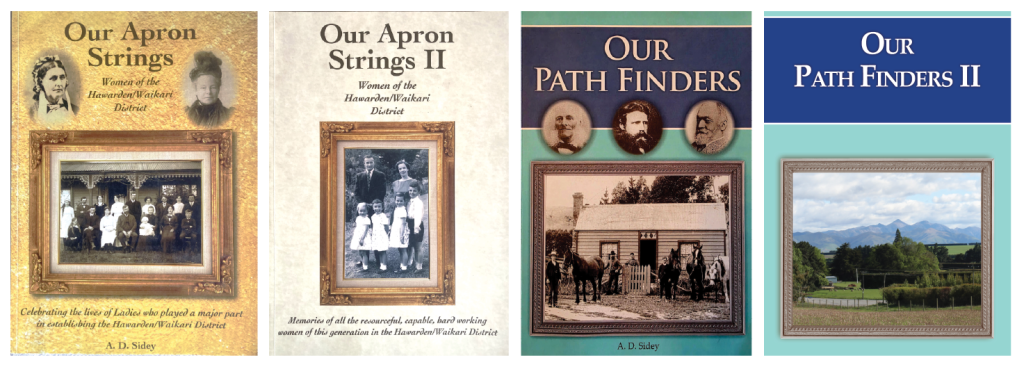
Apron Strings and Path Finders
The Hawarden-Waikari book project saw seven volumes, totalling nearly 2000 pages, published between 2009 to 2026 to raise money for local charities. The books feature more than 1000 biographies of locals who shaped the district from before 1920 to 1960. The seven books are:
Book 1 – Our Apron Strings, the stories of 170 local women born before 1920.
Book 2 – Our Guardians of Freedom, stories of locals who served New Zealand from the Boer War to the Vietnam War.
Book 3 – Our Path Finders, stories of men of the district born before 1920.
Book 4 – Our Apron Strings II, women of the district born between 1920 and 1940.
Book 5 – Our Path Finders II, men of the district born between 1920 and 1940.
Book 6 – Our Apron Strings III, women of the district born between 1941 and 1960.
Book 7 – Our Path Finders III, men of the district born between 1941 and 1960.
For more information, or to buy one of the Hawarden-Waikari books, go to www.hawarden-waikari.com.
Source URL: https://metropol.co.nz/apron-strings-and-path-finders/